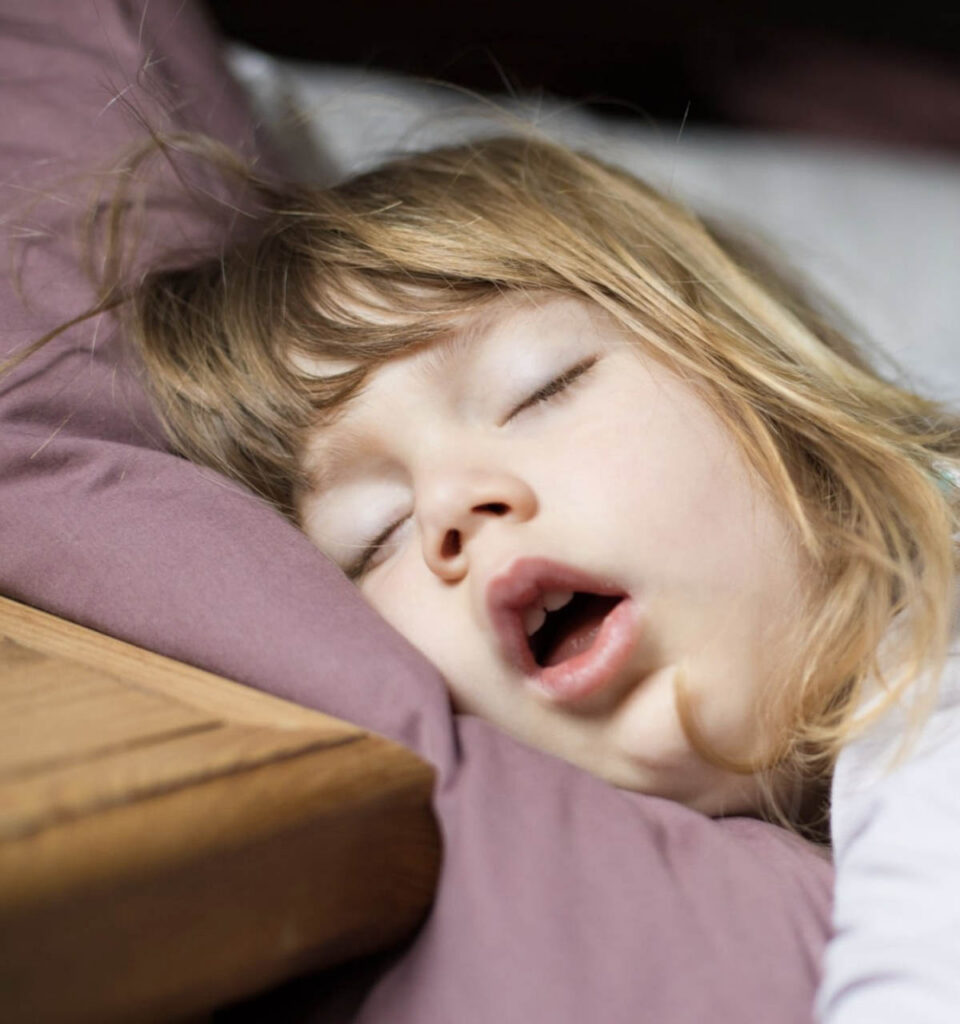
Mouth breathing in children can go unnoticed for years. Spotting it early can make a real difference to your child’s sleep, facial development, attention span and growth.
Some children sleep with their mouth open. Others snore, toss and turn all night, or wake up tired despite getting plenty of hours. Some struggle to concentrate, seem more irritable than usual, have dark circles under their eyes, or keep their lips parted for much of the day.
These signs are often written off as normal, or filed under “he’ll grow out of it.”
The opposite may well be true: growth is precisely when spotting these signs matters most.
Breathing through the mouth isn’t just a different way of breathing
Nasal breathing is how the body is designed to work. When a child breathes mainly through the mouth over a sustained period, there may be an underlying difficulty breathing properly through the nose, or a functional issue worth looking into.
And the knock-on effects can reach well beyond the mouth.
Mouth breathing in children can be linked to disrupted sleep, and it may be associated with changes in tongue posture, jaw position and facial growth patterns.
What’s more, when breathing is disturbed during sleep, the quality of that rest suffers. A child can spend many hours in bed and still not be resting properly.
A growing brain needs good sleep too
In childhood, sleeping well is fundamental to brain development.
When sleep is repeatedly fragmented or poor in quality, it can show up as difficulties with attention, concentration, memory, learning, school performance, irritability or behaviour.
In some children, these daytime signs are mistaken for a lack of discipline, too much energy, or an attention problem.
So when certain signs are present, the question shouldn’t only be:
“How many hours does she sleep?”
It should also be:
“How does she breathe while she’s asleep?”
The face and jaws are still growing
Throughout childhood, the bones of the face are actively developing.
Where the tongue habitually rests, how the lips sit, the position of the jaw and the way a child breathes are all part of the functional environment in which that growth takes place.
A sustained pattern of mouth breathing can be associated with certain changes in dentofacial development, such as a narrow palate, not enough room for the teeth, particular types of malocclusion, or changes in the facial growth pattern.
Waiting until all the permanent teeth have come through can therefore mean missing a particularly valuable window — both for spotting a problem and, where appropriate, for acting on the factors behind it.
Which signs are worth paying attention to?
Signs that justify having a child assessed include:
- Regularly sleeping with the mouth open.
- Frequently breathing through the mouth during the day.
- Snoring on a regular basis.
- Restless sleep, or a lot of movement through the night.
- Waking up tired.
- Persistent dark circles under the eyes.
- Dry lips first thing in the morning.
- Ongoing difficulty breathing through the nose.
- A narrow palate, or not enough room for the teeth.
- Trouble with attention or concentration.
- Irritability or changes in behaviour.
- Underperforming at school with no clear explanation.
Any one of these on its own doesn’t necessarily point to a medical problem, but it is reason enough for a professional assessment.
Spotting something isn’t the same as treating it — it means understanding what’s going on
This point matters.
The purpose of early detection is not to put a child through treatment they don’t need.
It’s to work out whether there is a problem, understand where it might be coming from, and decide whether we simply keep an eye on it or whether further assessment is needed.
Depending on the case, this may call for several professionals working together — paediatric dentistry, orthodontics, ENT, or speech and myofunctional therapy.
Every child is different, and when treatment is needed, it should address the cause.
BREATHE: looking beyond the teeth
At Advance Dental Institute we’ve developed BREATHE, our approach to assessing breathing and growth in children.
The aim is to look at the child as a whole, considering together everything related to:
breathing + sleep + facial growth + oral development + function
Because the first signs often appear in the mouth long before parents have any idea that a breathing or sleep problem might exist.
That’s where paediatric dentistry can play a real part in early detection, and in referring on to the right specialist when that’s what’s needed.
Some windows in a child’s growth don’t come round again
Not every child who sleeps with their mouth open has a significant problem.
Not every child who snores needs treatment.
But no child should spend years breathing or sleeping badly simply because nobody stopped to look.
Childhood is an extraordinary window for picking up on these things while the brain, the jaws and the face are still forming.
Spotting it early doesn’t mean more treatment.
It means having the chance to act at the right moment.
Does your child sleep with their mouth open, snore, or breathe through the mouth most of the time?
We can carry out a dedicated assessment of their breathing, sleep and dentofacial development at Advance Dental Institute, Bendinat (Mallorca).
BOOK AN APPOINTMENT – BREATHE
DISCOVER BREATHE – CHILDREN’S BREATHING AND GROWTH